
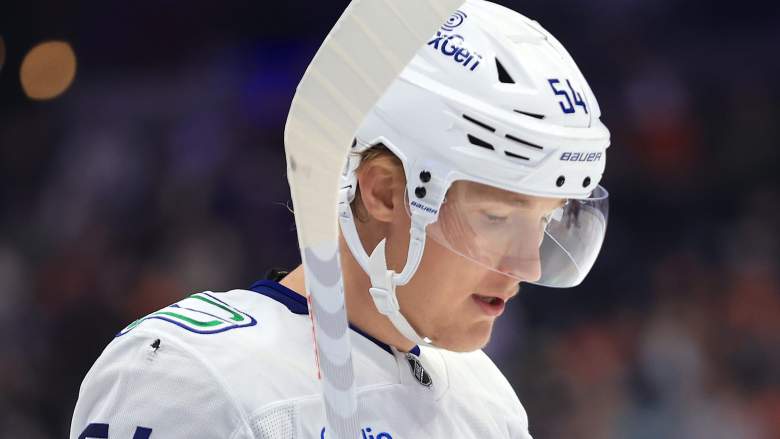
When the Vancouver Canucks traded their former captain Bo Horvat to the New York Islanders in January 2023, the hope was to transform a potential contract standoff into an organization-defining move.
Nearly four years later, the deal has aged like sour milk.
Horvat was in the middle of contract uncertainty, so the organization decided it wouldn’t risk losing its best player for nothing.
So, Vancouver pulled the trigger. The Canucks got back forward Anthony Beauvillier, prospect Aatu Räty, and a protected first-round pick in the 2023 NHL Draft. On paper, it was a reasonable return for a player who was approaching unrestricted free agency. The problem is what Vancouver actually got out of it.
Beauvillier failed to establish himself as a long-term solution, eventually prompting the Canucks to sell low on him, getting just a fifth-round pick. Räty offered something more intriguing: a young center who could develop into a top-six player and potentially fill the hole Horvat left behind.
As for that first-round pick, the organization flipped it to the Detroit Red Wings in the Filip Hronek trade.
Now, with the Canucks trading Räty to the Toronto Maple Leafs for forwards Brandon Buhr and Jacob Quillan on October 15, the original Horvat deal deserves another look. The individual moves made along the way were not all indefensible, but the overall return looks even more awful now than it did a few days ago.
Canucks Never Got What They Hoped From Aatu Räty
Räty was arguably the most intriguing piece of the Horvat trade. Beauvillier was an established NHL forward, and the first-round pick offered a relatively straightforward asset. Räty, however, gave Vancouver a chance to develop its next young center.
Räty was supposed to be the key to the deal.
Horvat had been an important part of the Canucks’ lineup, providing goal-scoring and defensive responsibility down the middle. Replacing that production was never going to be easy, but Räty offered a longer-term option who could grow into the role rather than forcing Vancouver to find another expensive veteran.
There were reasons for optimism. Räty showed promise in the AHL, including a strong 2024-25 season with Abbotsford, where he helped the team win the Calder Cup. He also received opportunities with Vancouver, appearing in 66 games during the 2025-26 season.
The problem was that the potential never translated into a dependable NHL role. Räty recorded four goals and 14 points last season, and his place in the lineup remained uncertain. At the start of the 2026-27 campaign, he appeared in only four of Vancouver’s first eight games, scoring once while spending time as a fourth-line center.
The arrival of Manny Malhotra as head coach made the situation particularly interesting. Malhotra had previously coached Räty in Abbotsford, giving him firsthand experience with the young center. Yet that familiarity did not result in a more prominent role for Räty in Vancouver. He was placed on waivers on October 14, a clear sign that the organization no longer viewed him as an essential part of its NHL plans.
Räty cleared waivers the following day before the Canucks traded him to Toronto. Vancouver received two forwards in return, but neither player changes the bigger picture: The organization has moved on from the prospect it once hoped could become a meaningful piece of the Horvat return.
That does not mean Räty cannot develop elsewhere. Toronto should provide him with a fresh opportunity, and young centers can take different paths to establishing themselves. But Vancouver cannot evaluate the original trade based on what Räty might eventually become for another team. The Canucks had their chance to develop him, and the relationship ended without the top-six center they hoped to find.
Filip Hronek Is a Good Player, but the First-Round Pick Still Stings
The other major piece of the Horvat trade became Filip Hronek. In March 2023, Vancouver sent the Islanders’ conditional first-round pick and its own second-round selection to Detroit in exchange for Hronek and a fourth-round pick.
Hronek has provided real value. He is a right-shot defenseman capable of playing major minutes, contributing offensively, and helping stabilize the right side of the blue line. Vancouver subsequently signed him to an eight-year contract with a $7.25 million average annual value in June 2024. It would be unfair to describe that acquisition as a failure simply because the Canucks later entered a rebuild.
Still, the cost of acquiring him deserves scrutiny. The first-round selection became the 17th overall pick in the 2023 NHL Draft, which Detroit used to select defenseman Axel Sandin-Pellikka. The Red Wings also received Vancouver’s second-round pick, which they used on forward Felix Nilsson.
Sandin-Pellikka represented a chance to add a young defenseman who could develop alongside Detroit’s existing core. Vancouver, meanwhile, used those selections to acquire a player who was already established at the NHL level. That was a defensible decision if the Canucks believed they were building toward contention.
But circumstances have changed. Vancouver is rebuilding, and Hronek’s value may be greater to another team seeking an established top-four defenseman than it is to a club still trying to assemble its next competitive core. His long-term contract complicates any potential trade, and there is no guarantee the Canucks will move him. Still, it is reasonable to question whether he will remain part of the team’s plans throughout the rebuild.
That is the uncomfortable part of the Horvat trade. Vancouver did not simply turn its captain into nothing. It eventually acquired a useful defenseman, and the organization had understandable reasons for moving quickly to address its blue line. But Beauvillier departed for a fifth-round pick, Räty was traded after failing to secure a lasting role, and the first-round selection became part of a deal whose long-term fit is now uncertain.
The Canucks faced a difficult decision when Horvat’s contract situation reached a crossroads. The trade itself was not necessarily a mistake at the time. The more troubling reality is that, nearly four years later, Vancouver has little of the original return to show for it, and the pieces that remain have yet toprovide a clear foundation for the next competitive team.
Canucks Bo Horvat Trade Looks Even Worse After Aatu Räty Deal