
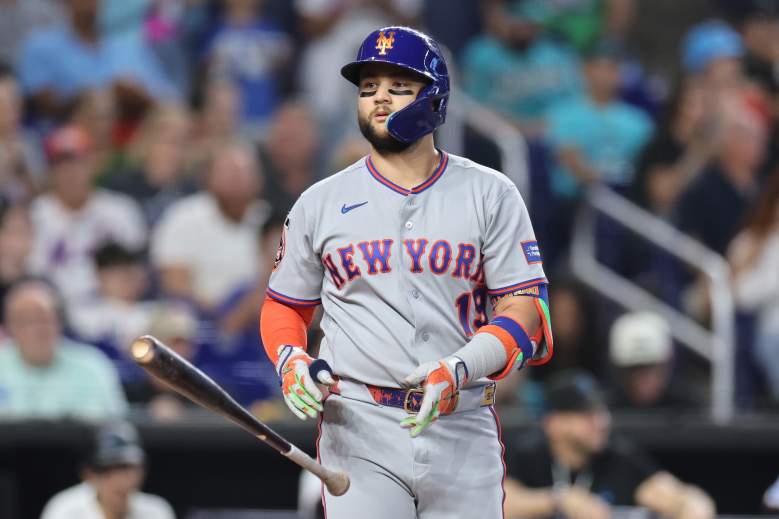
Bo Bichette could leave the New York Mets this offseason.
Despite them signing him to a three-year contract last winter, the infielder actually has opt-outs built in after each season. It functions like three one-year deals that Bichette has full control over whether it advances to the next or not.
There are legitimate reasons that Bichette could consider an opt-out, to be sure.
On the flip side, though, are a bunch of reasons that Bichette should probably opt-in and remain with the Mets for next season.
Those reasons mostly have a dollar sign next to them.
Bo Bichette Decision
Bichette’s decision ties heavily into what he’s due to be paid if he remains on the deal.
It was a three-year, $126 million contract, which means an annual average value of $42 million per year.
Could he really beat that on the open market?
“Despite the argument above, it makes little financial sense for Bichette to decline the final two years on his contract,” MLB.com’s Anthony DiComo wrote in a new article on Thursday. “His deal’s $42 million average annual value is tied for sixth-highest in Major League history, behind only Shohei Ohtani, Kyle Tucker, Juan Soto, Max Scherzer and Justin Verlander.”
It’d be one thing to go after bigger money if this had been a good season for Bichette. It wasn’t, though. His OPS started with a 6, rather than his previous career OPS of .806.
“Bichette did not play like a $42 million player in 2026, and it’s debatable if he was at that level even before signing his deal; at the time, Bichette’s career .806 OPS ranked 39th among active Major League players,” DiComo writes. “In 2026, Bichette’s career OPS fell to .788, which now ranks 53rd among active players. Even in a thin free-agent market for hitters, it would be next to impossible for Bichette to come anywhere close to a $42 million AAV with a new team.”
Another Decision Looms
The other truth is that Bichette doesn’t just have this opt-out — he has another one next winter.
Bichette doesn’t have to opt-out and settle now when there’s a chance for him to have a better season before becoming a free agent.
“If he returns to the Mets now, plays well and then opts out a year from now at age 29, Bichette could set himself up for more total money than he would receive in any other scenario,” DiComo writes. “Or, if he likes what’s happening in New York, he could simply play out his entire contract and become a free agent again at age 30 — $86 million richer than he is today. In those scenarios, there are very few bad outcomes for Bichette.”
Historic Salary Can Keep Bo Bichette With New York Mets