

The Toronto Blue Jays have another contract tool to consider while pursuing Tarik Skubal: the division between regular salary and signing bonuses.
That structure cannot replace a competitive offer. It can change how much financial risk a player carries into an offseason shadowed by a possible labor stoppage.
ESPN’s Jeff Passan reported that Toronto met with Skubal. No public reporting cited here establishes that the Blue Jays have offered him a particular bonus structure. The relevant precedent already exists in their own clubhouse, inside Vladimir Guerrero Jr.’s contract.
Guerrero’s Contract Shows How the Mechanism Works

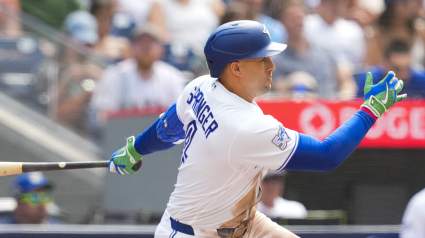
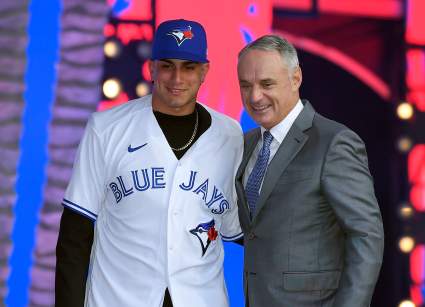
Sportsnet’s Shi Davidi documented Guerrero’s payment schedule when Toronto announced his extension. For 2027, it includes $14 million in signing-bonus installments and $17 million in regular salary, totaling $31 million.
The bonus portion represents approximately 45.2% of that year’s scheduled compensation. Davidi explained that signing bonuses remain payable during a labor interruption, protecting that regular salary does not necessarily offer when games disappear.
A signing bonus can also arrive in installments, as Guerrero’s scheduled payments show. The benefit depends on contract language and due dates, rather than assuming all bonus money changes hands on signing day.
The MLBPA lists December 1 as the agreement’s expiration date. Expiration does not itself establish that games will be canceled or determine the terms of any eventual settlement.
For illustration, consider two hypothetical $40 million annual payment packages. One contains only a regular salary. The other contains $30 million in salary and a $10 million signing bonus.
If half of the regular salary were lost, with no later recovery, the first would pay $20 million and the second $25 million. Those are explanatory assumptions, not reported Skubal terms or a forecast of a stoppage.

Toronto Would Be Accepting More Risk Too

The difference is economically meaningful even though the normal payment total remains identical. A bonus can make an offer more attractive by shifting a particular risk from player to club.
Toronto would remain responsible for that bonus payment even if the circumstances reducing regular salary also reduced its baseball revenue. Ownership would need to decide how much certainty it wants to purchase for a free agent.
The structure also does not create a simple luxury-tax escape. The current Basic Agreement allocates signing bonuses across guaranteed contract years for Competitive Balance Tax purposes. Relabeling compensation does not make it disappear from that calculation.
Nor should Guerrero’s arrangement become a claim about Skubal’s preferences. Different players can value payment timing, guarantees, geography, and competitive opportunity differently. Toronto would need to negotiate those priorities rather than assume an existing teammate’s contract supplies the answer.
Still, the comparison gives fans a better way to evaluate any eventual agreement. Total guarantee and annual average matter, but payment composition can matter alongside them.
If Toronto tries to distinguish its offer through bonuses, the meaningful question will be how much additional certainty it gives Skubal and how much risk the Blue Jays accept in return.












Blue Jays Could Borrow a Familiar Contract Blueprint in Cy Young Pursuit