
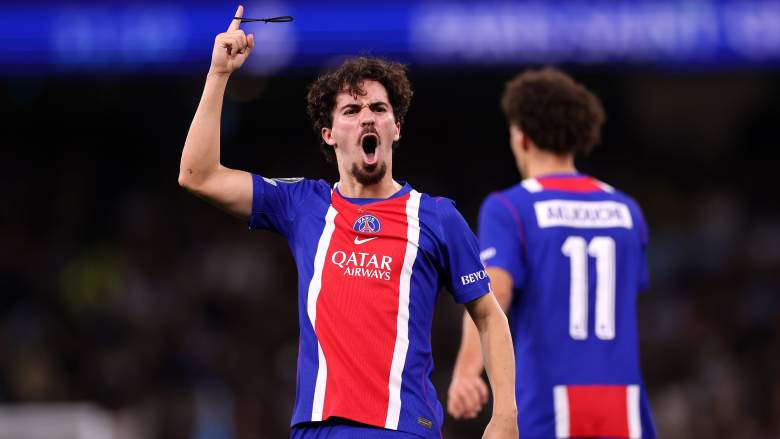
Eight changes to the starting lineup. Several of Paris Saint-Germain’s biggest stars watching from the bench. And a Champions League showdown with Barcelona just three days away. Luis Enrique’s team has made its priorities clear ahead of Saturday’s trip to Strasbourg, and the familiar argument about the strength of Ligue 1 is back.
PSG arrive after an impressive 4-2 victory over Manchester City on Wednesday, a result that underlined their ability to compete with Europe’s best. Now, with Barcelona visiting Paris on Tuesday, Enrique has chosen to manage his squad rather than send out the same team again. The official PSG lineup confirms the scale of the changes, with Ousmane Dembélé, Désiré Doué, Vitinha, Achraf Hakimi, Nuno Mendes, Willian Pacho and Fabián Ruiz among the regulars named on the bench.
Is that simply sensible squad management? Or does PSG’s ability to make so many changes without abandoning its domestic ambitions expose a problem with the French league? Both arguments deserve a hearing.
The Case Against PSG: Is Ligue 1 Becoming a Training Ground?
The criticism is easy to understand. Elite Premier League clubs face intense competition at home, where dropping points against mid-table opponents can derail a title challenge. PSG, by contrast, have built a squad with enough quality to rotate heavily and still field a formidable team. That depth becomes particularly valuable when European matches arrive every few days.
The concern goes beyond whether Strasbourg can take points from PSG. When the French champions can rest so many established starters ahead of a major European match, it raises questions about the level of domestic competition they face compared with their Champions League rivals. The “farmer’s league” label is deliberately insulting, but the underlying question is legitimate: how much does domestic competition prepare a team for the biggest European nights?
There is also a financial dimension. French football has struggled to secure the television income its clubs need, and the latest rights arrangements remain a major challenge. The French league launched its own Ligue 1+ streaming service after years of disruption in the domestic broadcasting market. The league is now selling its entire domestic schedule through its own platform, but building a sustainable business is a different challenge from simply putting matches on screen.
A competition needs compelling games, recognizable stars and uncertainty to attract casual viewers. If PSG’s dominance makes the title race feel predictable, broadcasters and supporters may reasonably ask what makes the product special. Seeing the champions treat a league match as an opportunity to rest key players will not help that perception.
The Case for PSG: Why Should Success Be Punished?
There is, however, a strong counterargument. PSG have not broken any rules by rotating their team. Their players have demanding schedules, and protecting them from fatigue and injury is part of a manager’s job. The match against Strasbourg is not an isolated event: it falls between a demanding European away game and another important Champions League fixture.
Nor are PSG responsible for the fact that their squad is stronger than most of their domestic rivals. Clubs across Europe invest in depth because it gives them a better chance of competing on multiple fronts. If PSG have built a squad capable of challenging for the Champions League while remaining competitive in Ligue 1, why should they deliberately make themselves weaker?
There is another important distinction. Rotation does not automatically mean a lack of respect for the domestic competition. Enrique has still selected a team containing Khvicha Kvaratskhelia, Ferran Torres, Maghnes Akliouche and Warren Zaïre-Emery. Several established players are available from the bench if the match demands them. The selection is evidence of squad management, not proof that PSG consider the game unimportant.
And the financial argument cuts both ways. PSG’s resources give them an advantage, but weakening the club would not automatically make the rest of French football healthier. Better distribution of revenue, stronger commercial deals and more competitive squads across the league would address the underlying problem more directly than expecting PSG to leave their best players on the pitch.
The Real Problem May Be Bigger Than PSG
The uncomfortable truth is that PSG’s dominance and Ligue 1’s financial difficulties feed into the same debate. The club’s resources help it attract elite players and compete in Europe. That success raises its profile, while the gap between PSG and most (if not all) domestic opponents can make the league harder to market as a genuinely competitive title race.
But the reverse is also true: a stronger domestic competition would give PSG more demanding matches, create more compelling television and help French clubs develop players capable of challenging the biggest teams. That is not something PSG can deliver alone, and it is not something that can be fixed by criticizing one team selection.
The comparison with Bayern Munich’s long dominance of the Bundesliga or Juventus’ previous grip on Serie A is instructive. Financial power can concentrate success at the top of any league. The challenge is creating a structure that allows other clubs to grow without punishing the clubs that have already succeeded.
PSG are operating rationally within the rules. Their critics are also justified in asking whether a league that allows one club to build such an advantage is healthy in the long term.
So where does that leave the “farmer’s league” debate? PSG’s rotation is not proof that Ligue 1 is uncompetitive, just as one impressive Champions League victory does not settle every question about its quality. But it does offer a snapshot of the imbalance that has made the argument so persistent.
Should PSG be criticized for using their squad intelligently, or should French football be asking why the gap has become so large? The answer may depend on whether you see the problem as one club’s advantage or an entire league’s challenge.
PSG’s Heavy Rotation Reopens the ‘Farmer’s League’ Debate Again