
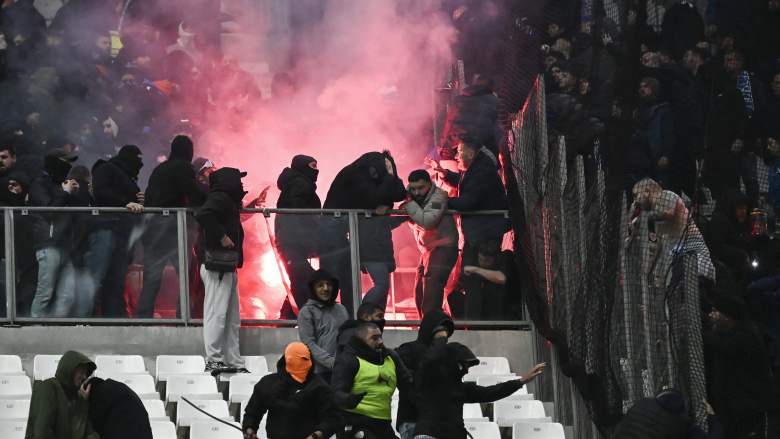
Across Europe this week, the beautiful game once again became a staging ground for much uglier forces—and the pattern of soccer politicized violence is rapidly spiraling out of control. In Marseille, Sunderland, and Batumi, political provocations, extremist gestures, and geopolitical flashpoints spilled directly into open brawls inside the stands. Matches continued and points were awarded, yet images of bloodied faces, metal pipes, pepper spray, and fleeing families completely overshadowed the football. What should have been routine Europa League nights instead delivered a grim warning of how quickly global politics can turn a stadium into a battleground.
Marseille: Mob Violence, Failed Policing, and Unforgivable Attacks
Ten minutes before kickoff at the Stade Vélodrome, hundreds of Olympique de Marseille ultras stormed toward the Levski Sofia away section armed with metal pipes, belts, and flares, smashing directly into the visiting Bulgarian supporters. Video footage circulating afterward captured masked home fans beating a woman and raining blows down on trapped visitors. Eleven Bulgarian supporters were injured and six required hospital treatment, including one fan who suffered a brain haemorrhage and a fractured skull, while two French riot police officers also sustained minor injuries.
Accounts differ on what triggered the assault. A Reuters photographer and French media reported that Levski supporters performed Nazi salutes and other provocations in the away end, while Levski insisted its fans were attacked first. Marseille supporters later chanted “Siamo tutti antifascisti” (“We are all antifascists” in Italian) during their team’s 1-0 victory, and French prosecutors have opened twin investigations into aggravated assault and incitement to hatred. French President Emmanuel Macron condemned the violence “with the utmost force.”
Make no mistake: if Levski fans displayed Nazi salutes, they deserve heavy punishment – but by UEFA, not an angry crowd. Whatever happened in the away end simply cannot excuse what followed. Watching armed home supporters storm a section and beat up a woman in the stands crosses every line of decency, and Marseille’s failure to provide adequate segregation and policing inside its own stadium makes the club directly culpable. UEFA cannot afford half-measures here—maximum sanctions against Marseille, alongside strict accountability for every club involved in this week’s chaos, are essential before European matchdays spiral completely out of control.
Sunderland: Banned Ultras Slip In and Chaos Follows
In northern England, Polish side Jagiellonia Białystok supporters were already barred by UEFA from attending their Europa League fixture at Sunderland following earlier crowd trouble, including incidents tied to a previous meeting with Levski Sofia. Despite the ban and Sunderland’s efforts to cancel suspicious ticket purchases, roughly 50 to 100 Polish fans still managed to infiltrate the home North Stand.
Fights broke out early in the 1-1 draw before police forcibly removed the group and made seven arrests, including three on suspicion of assaulting officers. Home supporters described scenes of panic as pockets of away fans suddenly began throwing punches, while witness reports also alleged that some of the infiltrators performed Nazi salutes. Sunderland blamed Jagiellonia for failing to cooperate and launched a review into how tickets reached banned supporters, whereas the Polish club countered that UEFA only prohibited an official away allocation and argued the individuals were not part of an organized group. Either way, a stadium ban proved meaningless once political and nationalist hostility walked straight through the turnstiles.
Batumi: Pro-Palestine Banner Triggers Police Clash
In Georgia, geopolitical conflict halted a match outright. UEFA had already relocated Beşiktaş’s home fixture against Israeli side Hapoel Be’er Sheva from Istanbul to Batumi for security reasons, and tensions were visible before kickoff when Beşiktaş players declined to shake hands with their opponents. In the 26th minute, play was suspended for roughly half an hour after Beşiktaş supporters unfurled a large banner reading “Revolt against the occupation, freedom for Palestine,” waved Palestinian flags, and chanted anti-Israel slogans.
Georgian riot police entered the stands, deploying pepper spray as seats were torn out and hurled, leaving one supporter carried out on a stretcher. Sixteen Beşiktaş fans were detained and three Georgian interior ministry staff members were injured. Georgian authorities maintained that supporters turned violent before any flags appeared and insisted UEFA delegates, rather than police, removed the banners. Beşiktaş and Turkish officials strongly rejected that account, accusing security forces of “disproportionate” force. Turkey summoned Georgia’s ambassador, and all 16 detained supporters were eventually released following diplomatic intervention ordered by President Recep Tayyip Erdoğan. Beşiktaş won the match 2-1, and UEFA has appointed ethics and disciplinary inspectors to investigate both the Marseille and Batumi incidents.
A Fractured World Spills Onto the Pitch
These three nights were not isolated flare-ups; they are symptoms of a broader global fracture spilling onto the grass. In a deeply polarized climate, football stadiums have become convenient theaters for political scores to be settled. The young athletes on the pitch are often far removed from the conflicts projected onto their shirts—some openly disagree with their own governments’ policies—yet players and ordinary families pay the price in disrupted matches, physical injuries, and looming stadium closures.
Violence solves nothing. Nazi salutes are indefensible. Beating women and endangering families in the stands is unforgivable, and hurling stadium seats or charging police lines destroys the sport from within. When world politics hijacks the terraces, football loses its power as a shared language. UEFA’s disciplinary investigators and national prosecutors already have the video evidence in front of them—now they must hand down maximum, uncompromising sanctions before the next flare, the next salute, and the next riot arrive.
When Soccer Gets Politicized, Violence Follows Across European Stadiums