
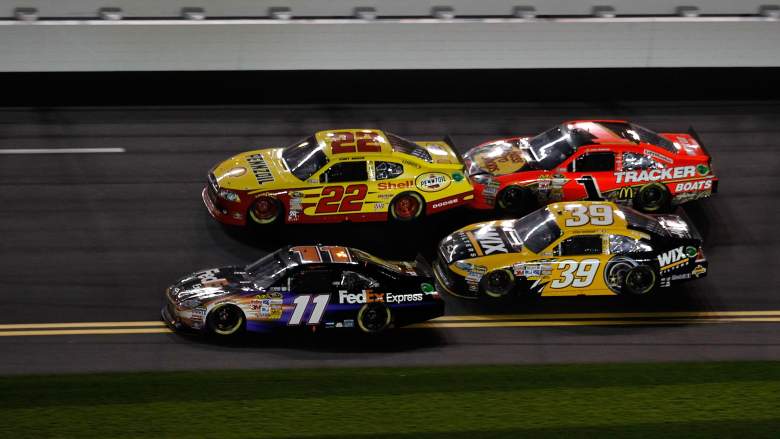
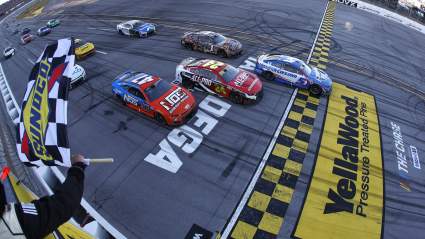
Few NASCAR rules spark more debate than the double yellow line. At Daytona International Speedway and Talladega Superspeedway, a driver can make a spectacular move toward the lead, only for the entire finish to come down to where their tires crossed a painted boundary.
But what exactly does NASCAR’s double yellow line rule prohibit, and why does it generate so much controversy?
Here’s what fans need to know.
What Is NASCAR’s Double Yellow Line Rule?
NASCAR’s double yellow line rule prohibits drivers from advancing their position by going below the yellow boundary lines that mark the inside of the racing surface at Daytona and Talladega.
The rule applies throughout the race, including the final lap. A driver cannot legally gain positions by using the apron below the double yellow line as an additional passing lane.
Importantly, the rule concerns advancing position below the boundary, not simply completing a pass while below it. NASCAR can determine that a violation occurred even if the driver finishes the pass after returning to the racing surface.
Drivers may also face penalties for forcing another competitor below the boundary to prevent a pass.
What Happens if a Driver Crosses the Double Yellow Line?
A driver who illegally advances below the double yellow line can be penalized by NASCAR.
During a race, officials may require the driver to serve a pass-through penalty on pit road. If the violation occurs at the finish, NASCAR can adjust the finishing order.
However, simply touching or driving on the yellow line does not automatically constitute a violation. NASCAR must evaluate whether the driver went below the boundary and whether the move resulted in an illegal advancement.
That distinction is often difficult to judge when cars are running inches apart at nearly 200 mph.
Why Does NASCAR Have the Double Yellow Line Rule?
The rule is intended to discourage drivers from using the apron to make passes during tightly packed superspeedway racing.
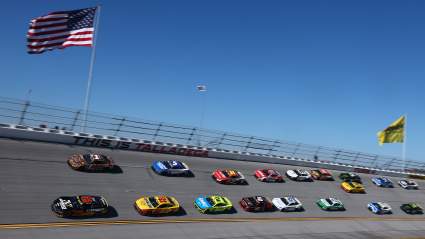
At Daytona and Talladega, cars frequently run two or three wide, with little room for mistakes. Allowing drivers to routinely pass below the racing surface could create additional hazards when they attempt to rejoin the pack.
The boundary establishes a clear limit on where competitors can race for position.
Still, the rule has remained controversial because determining whether a driver crossed that limit can require officials to examine multiple camera angles and interpret a rapidly unfolding incident.
Does the Double Yellow Line Rule Apply at Every NASCAR Track?
No. The double yellow line passing restriction is specific to NASCAR’s drafting races at Daytona and Talladega.
Other NASCAR tracks have different rules governing track limits and passing below the racing surface. Drivers may use portions of the apron at certain tracks without automatically receiving the same penalty.
That’s why a move that is legal at one speedway could result in a penalty at another.
Ultimately, the double yellow line rule is straightforward in principle: Drivers cannot gain positions by racing below the designated boundary at Daytona or Talladega.
Determining exactly when that happens, particularly in a photo finish, is where things get complicated.





What Is NASCAR’s Double Yellow Line Rule? Explained