
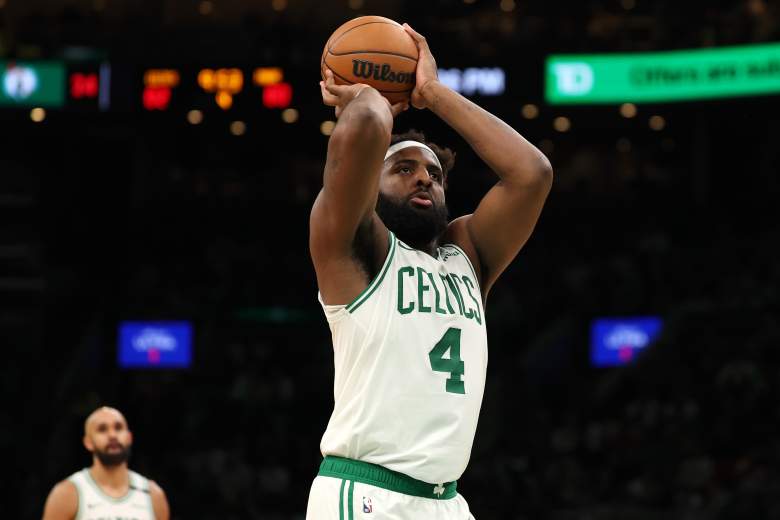
The New York Knicks faced a difficult decision last summer when Mitchell Robinson became a free agent—eight seasons of rebounding, rim protection and physical defense had made him a valuable part of their championship team.
Five months later, their decision to let him walk is looking increasingly defensible.
Robinson has struggled to establish himself with the Boston Celtics after signing a three-year, $47.4 million contract. His latest performance only reinforced questions about his fit.
In Boston’s 105-101 loss to the Denver Nuggets on Wednesday, Robinson endured a disastrous five-minute stretch that drew criticism league-wide.
Meanwhile, Andre Drummond, whom the Knicks signed for a fraction of Robinson’s salary, has quietly provided stronger rebounding production.
Mitchell Robinson’s Celtics Struggles Reach New Low
Robinson’s difficult adjustment was particularly evident against Denver.
During a 4-minute, 52-second stretch in the third quarter, Boston was outscored by nine points as its offense struggled with turnovers, poor spacing and missed connections.
NBA analyst Sam Vecenie was stunned by what he witnessed.
“I honestly do not think I have seen a player have a worse five-minute stretch in any game this season,” Vecenie wrote on X.
Robinson finished with six points and four rebounds in 16 minutes.
His overall production has also declined.
Through 14 games, the former Knicks center is averaging 5.1 points and 5.4 rebounds in 17.6 minutes.
His net rating stands at minus-6.5, while Boston has performed 24.4 points per 100 possessions worse with him on the floor than off.
Although those numbers reflect a small sample and different lineup combinations, they illustrate Robinson’s difficult start.
Conditioning has also been a concern as Robinson adjusts to Boston’s system. However, coach Joe Mazzulla has expressed confidence in his veteran center.
Andre Drummond Outrebounds Robinson at Fraction of Cost

The comparison with Drummond makes New York’s decision more compelling.
Through 15 games, Drummond is averaging 3.7 points and 7.3 rebounds in just 13.1 minutes.
That translates to an impressive 20 rebounds per 36 minutes, compared with Robinson’s 11.
Drummond also holds a considerable advantage in defensive rebounding rate, 33.6% to Robinson’s 17.1%.
Neither center has produced a positive net rating.
However, Drummond’s minus-2.9 is better than Robinson’s minus-6.5, while New York’s negative on/off differential with Drummond is considerably smaller.
Robinson remains the more efficient finisher, shooting 65.3% compared with Drummond’s 43.6%.
But the financial comparison favors the Knicks.
New York signed Drummond to a one-year deal worth approximately $3.9 million. Boston committed $47.4 million over three years to Robinson.
For a team navigating the NBA’s restrictive second-apron rules, that difference provides valuable flexibility.
Knicks’ Financial Gamble Shows Early Signs of Paying Off
Robinson’s departure wasn’t without consequences.
His offensive rebounding and rim protection helped New York win its first championship since 1973.
When healthy, Robinson remains capable of influencing games without needing plays called for him.
Still, the Knicks opted against another substantial long-term commitment to a center with an extensive injury history.
Drummond hasn’t replaced every aspect of Robinson’s defensive impact. His limited minutes also make direct comparisons imperfect.
But he has supplied strong rebounding production at a significantly lower cost.
Boston may yet get more from Robinson as his conditioning and familiarity improve.
For now, though, the early returns suggest the Knicks made a financially prudent decision — one that looks better with each difficult outing from their former center.















Knicks’ Mitchell Robinson Decision Looks Better as Celtics Struggles Continue