
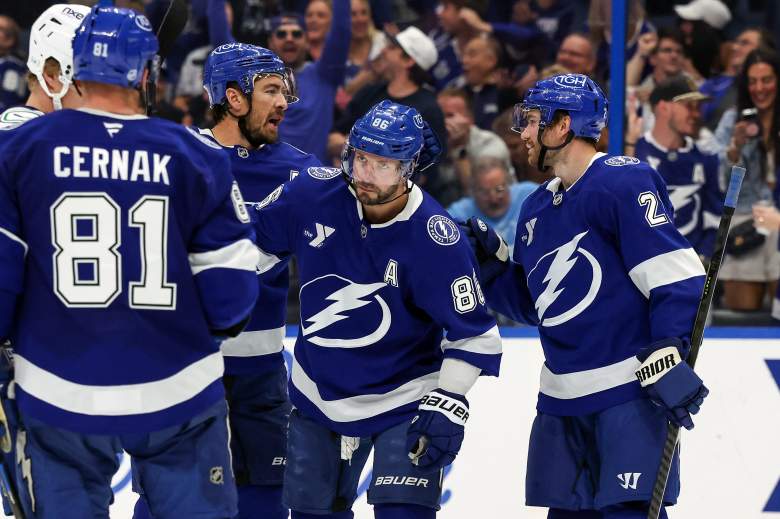
Nikita Kucherov has asked out of Tampa Bay, and Toronto is among the destinations he’d reportedly consider. Everyone is asking whether the Maple Leafs can win the trade. A better question is whether they can fit him in.
According to Elliotte Friedman of Sportsnet, Kucherov told the Lightning he won’t re-sign and wants to be moved. He later said the Leafs and Canadiens are teams the reigning Hart Trophy winner would consider. He has a modified no-trade clause covering 10 teams, and the full list hasn’t been made public. Tampa GM Julien BriseBois has said he doesn’t plan to trade him.
The Rule Few People Are Talking About
Enter tagging room, an obscure cap nuance explained by PuckPedia’s Hart Levine. It’s the space a team has left to add next season’s commitments while still playing this one. Right now, the Leafs have $648,000 of it, the lowest in the NHL.
They got there by stacking multi-year deals for depth forwards, then extending Kirill Marchenko at $12.5 million per season starting next year. The tagging crunch already forced the Marchenko-Knies trade to be reworked.
Why it Matters Moving Forward
There is good and bad news if the Maple Leafs are seriously considering a pitch for Kucherov. His $9.5 million cap hit expires after this season. As such, that wouldn’t impact the Leafs remaining tagging room since it only counts 2027-28 money. As a rental, it doesn’t come into play.
The harder part is keeping him. An extension counts against tagging room the moment it’s signed. Friedman reported that Kucherov initially sought a contract in the neighborhood of Kirill Kaprizov’s $17 million per year (now as high as $20 million). Toronto can’t sign any deal like that immediately.
Levine responded to my message for clarification on the rule, and when I asked if it would impact signing Kucherov, he explained:
“Yes, any contract for next season requires tagging room. They currently have $650K of space. So if they trade for him and don’t remove anyone from their roster, they cannot even afford to sign him to a league-minimum extension. They would be able to sign him on July 1 when the offseason formula changes to the new 27-28 cap + 10%.”
Maple Leafs Would Have to Cross Their Fingers Or Trade Term
Any realistic offer would likely include players with term, freeing up tagging room. The question is whether they can clear enough. It would also limit what Toronto could take back from Tampa, since adding anyone with a 2027-28 contract is off the table for now.
Tagging is a structural problem that requires the Maple Leafs to trade for the superstar but not sign him to an extension. That’s a huge risk. The Leafs would need to be convinced he’d sign long-term at 33 before surrendering major assets. Without being able to lock him in, they can’t (or at least shouldn’t) pay more than rental prices.
If the Leafs get serious, tagging won’t stop them, but it will shape the deal. A trade could work only if Toronto sends out term to make room for the extension. Until Kucherov’s list is known and BriseBois changes his stance, this is a possibility, not a front-runner.















Possible Maple Leafs Trade for Nikita Kucherov Complicated by Hidden Rule