
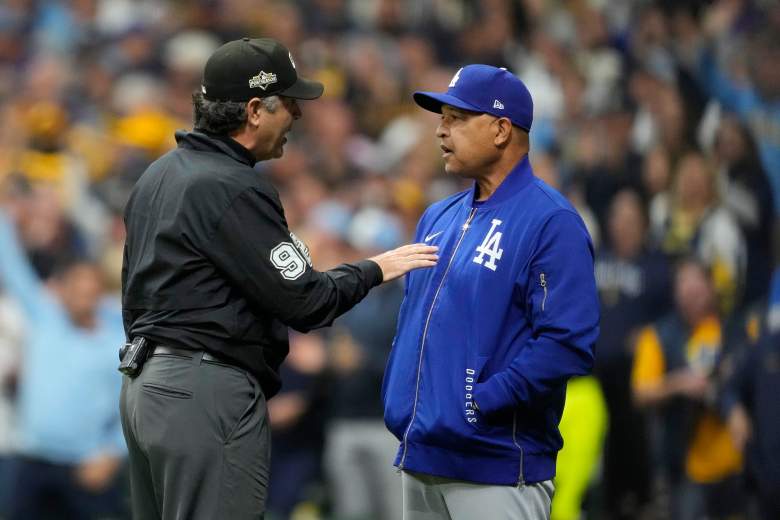
In baseball, checked swings are as much of an art as they are a science. And most art has no rules, only trends. The checked swing has always been one of baseball’s more subjective calls, if not the most subjective – but in light of the controversy over one in the 2026 World Series, footage available online from the fall classic from 61 years previously illustrates just how much the interpretation has changed over the years. And it is a lot.
A clip posted to YouTube shows several swings from the era that, by modern standards, would be difficult to describe as anything other than full attempts at hitting the ball. Yet they were treated as checked swings, with batters apparently getting away with movements that would absolutely certainly be called strikes in today’s game. Batters, it seems, could get completely fooled and get away with it.
The footage is a good illustration of how baseball’s unwritten conventions can evolve without any corresponding change to the official rulebook. In fact, the interesting thing about checked swings is that the rulebook has never actually provided a precise definition of one.

No One Really Knows What A Checked Swing Is
As has been made very well known in the aftermath of the World Series, under MLB’s Official Baseball Rules, there is no specific definition of a checked swing. Nor is there a written standard stating exactly how far a batter can move the bat before an attempt becomes a swing.
The rulebook’s definition of a strike includes a pitch at which the batter swings and misses, with the relevant wording referring to a pitch that is “struck at by the batter”. But what constitutes being “struck at” is ultimately left to the umpire’s judgement.
There is a provision in Rule 8.02(c) that allows the defensive team to appeal a half-swing on a pitch initially called a ball. The home-plate umpire can ask the first- or third-base umpire for assistance, depending on which side the batter is hitting from. However, this provision explains how an appeal is handled, rather than establishing a measurable definition of a swing.
That, then, leaves umpires relying on their own interpretation. And while that is by design, it also is a system that leaves nobody being quite happy about it. Commonly cited standards include whether the batter breaks his wrists, whether the bat crosses the plate, or whether the barrel moves far enough forward to constitute an attempt. None of these is an official MLB requirement. The result is that two very similar movements can produce different calls, depending on the umpire making the decision. And if Rule 8.02(c) is invoked, the solution is then to have two people’s subjective thoughts rather than one, which sounds like no solution at all.
One Of History’s Most Important Checked Swings
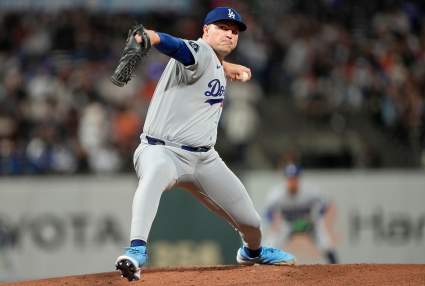
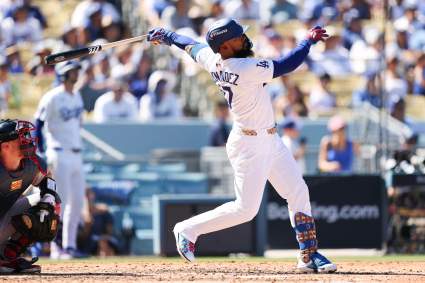
With the Milwaukee Brewers leading 5-4 in the ninth inning of Game 2, the Rays had a runner on third base and two outs when Yandy Díaz came to the plate. Facing a full count against Milwaukee pitcher Aaron Ashby, Díaz attempted to hold up on a breaking ball.
Home-plate umpire Jim Wolf initially ruled that Díaz had checked his swing. However, Brewers catcher William Contreras appealed the decision, and first-base umpire James Hoye ruled that Díaz had gone around. The resulting strikeout ended the game, giving Milwaukee a 5-4 victory and a 2-0 lead in the series.
It was an exceptionally close call, and the replay did little to settle the argument. Díaz clearly began moving his bat towards the pitch, but whether he had committed sufficiently to constitute a swing was another matter. By old standards though, the answer would have been no; not even nearly.
The contrast between any modern checked swing such as Diaz’s, and the historic footage of above, is startling when considering how much stricter the modern interpretation has become. In the footage – taken from Los Angeles Dodgers legend Sandy Koufax’s three-hit shutout with 10 strikeouts in the decision Game 7 of the 1965 World Series – two Minnesota Twins hitters take almost entirely full hacks, getting leniency for “checking” their swing by slightly pulling out at the last second. Long, long after their bats have broken the plane of the plate. Yandy would never claim that was a checked swing in the modern day. No one would.

More Sensible System Might Be On The Way
Interestingly, MLB has already been experimenting with a more objective approach to the problem in the minor leagues. A checked-swing challenge system was tested in the Arizona Fall League in 2024 before being introduced in the Single-A Florida State League in 2025 and expanded to Triple-A in 2026. The technology uses Hawk-Eye tracking to determine whether the head of the bat moves beyond a 45-degree threshold relative to its starting position. Under that experimental standard, anything beyond the threshold is considered a swing.
It is not yet the standard used in Major League games. It does however demonstrates that the league recognises the difficulty of leaving such an important decision entirely to individual judgement. Something they got an unneeded reminder of with this week’s events.
The Koufax footage and the Díaz incident are separated by more than 60 years, but they illustrate the same underlying problem. Baseball has never established a precise definition of what constitutes a checked swing, leaving generations of umpires to develop and apply their own interpretations. Back in the day, a hitter could flail like they were trying to get out of a strait jacket, and as long as they only swung with 90% intent, they would get the call. Now, though, hitters need to know their planes.


Historical Footage Shows How Ridiculous Checked Swings Used to Be