
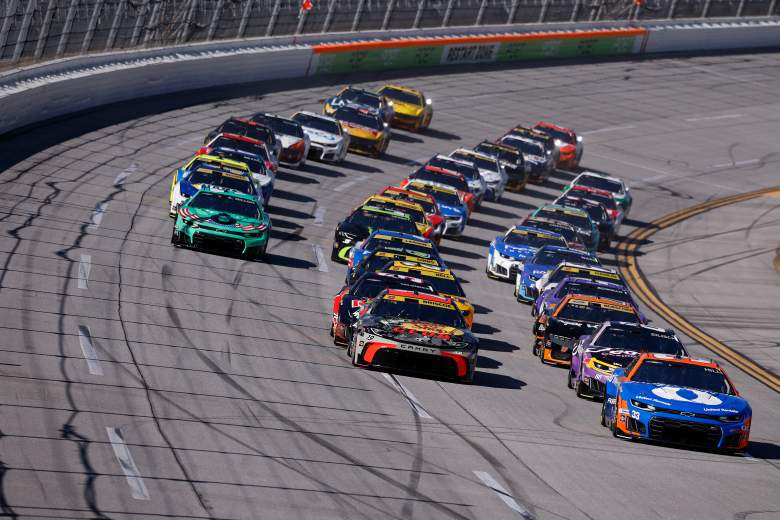
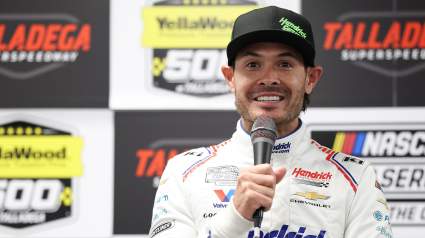
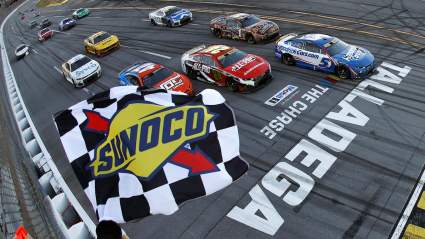
Kyle Larson kept his NASCAR Cup Series victory at Talladega Superspeedway after officials reviewed his final-lap move during Sunday’s YellaWood 500.
The Hendrick Motorsports driver raced through traffic before beating teammate William Byron by just 0.041 seconds. Larson’s final-lap push sparked debate over whether his No. 5 Chevrolet stayed within NASCAR’s double-yellow line rules as he worked his way past rivals.
Brad Moran said NASCAR’s review of multiple camera angles showed Kyle Larson had not crossed below the double-yellow line at Talladega. The rule bars drivers from using the area below the line to pass rivals or gain positions, making the position of Larson’s tires central to the decision.
Moran also addressed other incidents near the finish, explaining why officials reached different decisions. His comments detailed how tire position, possible accident avoidance and the circumstances of each move shaped NASCAR’s review.
NASCAR Explains Why Kyle Larson Avoided a Yellow-Line Penalty
NASCAR reviewed multiple camera angles before deciding Larson did not break the yellow-line rule.
“We certainly looked at it. We reviewed it, and in our judgment, the No. 5 was definitely on the line, not below it,” Moran said.
The rule prevents drivers from going below the double-yellow line to gain an advantage at superspeedway tracks. NASCAR places cameras around the corners, straightaways and tri-oval to help officials identify possible violations.
Moran also explained the standard NASCAR uses when deciding whether a driver deserves a penalty.
“You have to have your two left-side tires clearly below the yellow line to be penalized,” he said.
Moran said NASCAR found no grounds to penalize Larson because the No. 5 Chevrolet stayed within the yellow-line boundary.
NASCAR Addresses Other Talladega Yellow-Line Incidents
NASCAR Cup Series Managing Director Brad Moran said they factored in surrounding traffic and crash avoidance before ruling on the No. 1 and No. 77 cars’ yellow-line moves.
“We also looked at the No. 1 and the No. 77. They were below the line just at the exit of Turn 4,” Moran said.
He explained that NASCAR viewed the incidents as accident avoidance because the No. 34 car was moving down the track.
“We called that one basically accident avoidance. The No. 34 was coming down, and we called that part of racing.”
Moran said NASCAR weighed the risk of a crash when reviewing the close racing on the final lap.
“When it’s that close coming to the checkered flag, we felt that call was necessary to prevent a wreck, which we’ve called it that way in the past as well,” he said.
His explanation highlighted the role of context in NASCAR’s yellow-line decisions. Officials examine whether a driver deliberately crosses the boundary to gain an advantage or moves below it while reacting to another car.
NASCAR Clarifies When Drivers Face Yellow-Line Penalties
Moran clarified that drivers face penalties if they cross the double-yellow line to pass competitors or improve their position.
“If you clearly drive down below the double yellow lines to advance your position or make a pass, you’ll be penalized,” Moran said.
“And we do have, per our rule, that if you force someone down there, you may be penalized as well.”
Moran acknowledged the intensity of the racing during the final corner of the Talladega race, when drivers pushed hard to secure the win.
“So, yeah, last corner, last lap, they’re going for it. They’re doing what the fans want to see, and they’re racing hard. That’s how we looked at it.”
NASCAR upheld Kyle Larson’s Talladega victory after officials found no clear yellow-line violation during his final-lap charge. Moran’s explanation pointed to tire position, camera footage and the circumstances surrounding each move as key factors in the officials’ decisions.




NASCAR Addresses Backlash Over Kyle Larson’s Final-Lap Move at Talladega