
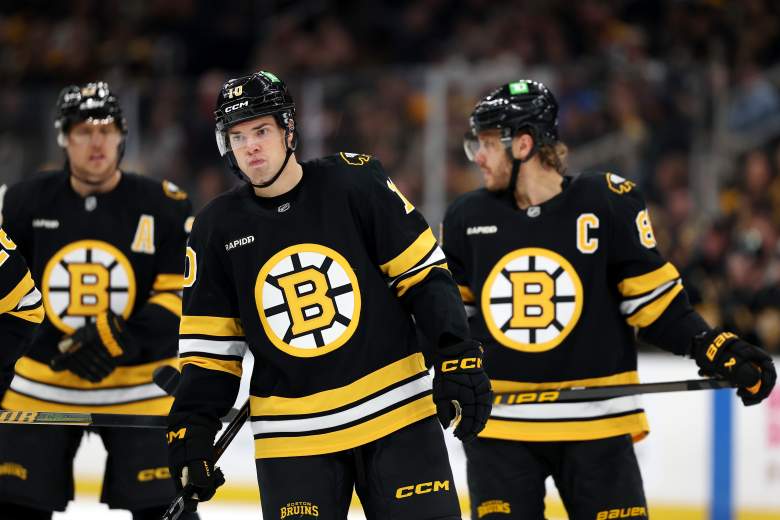
The Boston Bruins’ power play has been abysmal through the first four games of the season, and there is no question about it.
Boston’s power play went 0-for-4 against the Ottawa Senators, putting them at 0-for-10 for the year. Worse, Tim Stutzle scored a short-handed goal on Boston’s first power-play opportunity. Then three seconds after it ended, he struck again, giving Ottawa an early 2-0 lead.
It shows that Boston’s power play isn’t just failing to score. Now, it’s hurting them. Look no further than the fact that the Bruins lost on Monday night by three goals. Two of which came as a result of its own power play miscues.
Bruins’ Power Play Is Still Searching For Its First Goal
Boston entered Monday’s game 0-for-6 on the man advantage. Head coach Marco Sturm barely had a response to his team’s performance at 5-on-4.
Via Joe McDonald of NHL.com, Sturm said,
“It’s a good question. I really don’t know. I can’t give you an answer right now — honestly. We thought putting those guys back together because they had good chemistry, and we were a top 10 power play last year, (would) give them a little bit of comfort, but it kind of went the other way.
“Honestly, I have no idea why. I really don’t. I’ve got to look at some clips. As a group, you have to ask yourself, too, the guys who were on the ice on the power play, and as a group we have to get better.”
It’s an issue Sturm would rather figure out sooner rather than later. If Boston keeps hurting itself on the power play, it will cost them games they otherwise could have won.
Losing by three goals is one thing, but what if an errant power play leads to the deciding goal? That’s something the Bruins need to avoid in an Atlantic Division that could have seven teams capable of making the playoffs. And there is only room for five, tops.
Special Teams Is Becoming An Early Problem For The Bruins
The Bruins’ special teams issues aren’t relegated to the power play. Boston’s penalty kill was perfect on Monday night, but they entered the contest 4-for-7, good for just a 57.1 penalty-kill percentage.
The upside for the penalty kill was its stellar play on Monday. But the question, however, is whether Boston can keep the momentum going when they are a man down. The penalty kill also struggled last season, fending off opposing power plays just 76.98 percent of the time. That was well below the NHL average of 78.89 percent.
As for the power play? Boston boasted one of the better units in the league. In 2025-26, the Bruins converted 23.40 percent of their opportunities, over two percent more than the league average of 21.11.
It’s not like this unit hasn’t succeeded recently. It’s all about getting that groove back that the Bruins’ power play had last season. Boston has also struggled to score at 5-on-5. The Bruins are converting just 7.0 percent of their shots on goal despite 8.9 expected goals for the season.
They have converted just 4.3 percent of their high-danger chances and are 1-for-22 overall. If the Bruins want a repeat of 2025-26 and not a repeat of that disastrous 2024-25 season, they must figure out how to get consistent on special teams and start scoring in all phases of the game.
Bruins’ Power Play Hits Ugly Mark After Senators Loss